
How to Choose City Wall Art That Suits Your Space
Quick Summary
Start by measuring your wall and the furniture beneath it, aiming for city wall art about two-thirds of the furniture width. Then choose a city with personal meaning and an imagery type that suits the room's purpose and style.
- Measure the width of your sofa, console or headboard before buying any print.
- Let the art cover roughly two-thirds of the furniture width below it.
- Leave 15 to 25 centimetres between the top of a sofa and the frame's bottom edge.
- Choose a city that is your hometown, a travel favourite, or an aspirational destination.
- Use black-and-white prints for a calm, architectural feel and colour for warmth and energy.
Table of Contents
- Measure Your Wall Before You Choose a Size
- How to Choose City Wall Art for Living Room Spaces
- Pick a City and Style That Mean Something to You
- Choose Between Black and White and Colour City Prints
- Frequently Asked Questions
Measure Your Wall Before You Choose a Size
Last Updated: November 9, 2026
Choosing city wall art gets easier when you start with the wall, not the print. Buyers often fall for a skyline only to find it too small, too big, or lost above the sofa.
Measure the wall and the furniture beneath it: too small looks like a postage stamp, too large overwhelms the room.
- Measure the width of your sofa, console or bed headboard
- Note the height from the floor to where you want the print's centre
- Mark the outline with painter's tape before you commit
A common approach is to let the art cover roughly two-thirds of the furniture width. For a group of prints, measure the total arrangement—including frames and the spaces between them. A single portrait print may suit a smaller wall, while two or three coordinated prints can create a wider display above a sofa.
How to Choose City Wall Art for Living Room Spaces
A living room is a great place for a bold cityscape. Choose a wall that draws the eye, such as the space above your sofa.
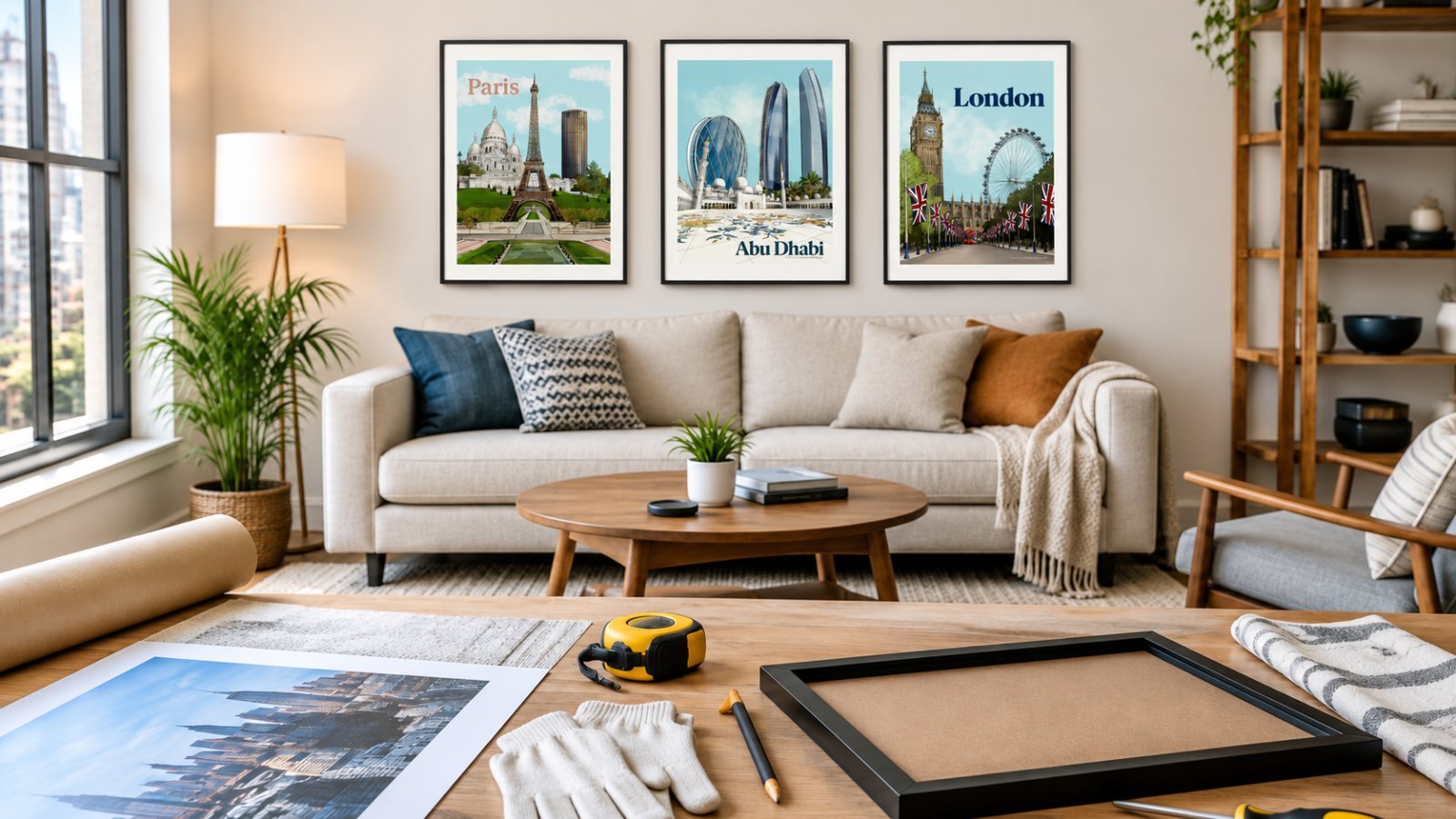
Hang the print so its centre sits at a height that keeps it visually connected to the furniture beneath it.
- Above a sofa: leave 15 to 25 centimetres of space between the top of the sofa and the frame's bottom edge
- Above a fireplace: follow the fireplace manufacturer’s clearance requirements and avoid exposing artwork to heat or soot.
- In a corridor: place smaller prints in a grouped row for balance
Viewing distance matters more than most buyers realise. Consider how far back the sofa or seating sits from the wall, and whether a larger piece or simpler skyline will read clearly from that distance.
Lighting and glare affect how clearly you can see your artwork. Our cityscape artworks are printed on archival, acid-free matte paper. If you choose a glazed frame, consider reflections from nearby windows and lamps when deciding where to hang it.
Coordinate with furniture and other room elements. Two or three portrait prints can create a balanced arrangement above a wide sofa, while a tall, narrow wall may suit a single portrait print or a vertical pair. Repeat a colour from your rug or cushions to connect the artwork with the room.
Use hanging hardware suited to your wall material and the complete frame’s weight. For masonry walls, read our guide on how to hang art on a concrete wall.
Pick a City and Style That Mean Something to You
The city you choose should carry personal meaning, where you grew up, where you met your partner, or somewhere you'd still love to visit. For ideas on turning those places into wall art, try curating your wall like a postcard.
Dublin City Print |Temple Bar →
A decision framework for meaningful city choices. Most buyers choose between three kinds of connection:
- Hometown or current city, grounds the room in where you are now; a map or skyline of your own city feels personal without being sentimental.
- Favourite destination or travel memory, a street scene or bold typographic print of a city you've visited carries more narrative than a generic skyline.
- Aspirational city, choose somewhere you would love to visit, with imagery that captures what draws you to that place.
Think about the room's purpose too: an entertaining living room can carry a bolder piece; a bedroom benefits from calmer, muted city imagery; a home office can take something more graphic.
Match the imagery type to the room and interior style. Maps, skylines, street scenes and abstract city imagery each behave differently on a wall:
- Maps suit studies, hallways and minimalist or industrial interiors; they reward close viewing, so place them where people can stand near them.
- Skylines are the most versatile and suit living rooms and dining rooms in almost any style.
- Street scenes bring energy and detail, working well in living rooms, kitchens and hallways with a travel or eclectic feel; choose a scene with a clear focal point rather than a crowded junction.
- Abstract city imagery can suit a range of interiors. Choose colours and shapes that complement the room’s existing patterns.
Style matters as much as subject. Consider the lettering as well as the illustration. Bold typography makes the city name part of the statement, while a subtle title gives the artwork a quieter presence, Paris City Skyline | Eiffel Tower Wall Art can anchor the room, while a smaller hallway suits a more understated piece.

Watch out: choosing a city purely because it's fashionable can leave you with art that feels impersonal after a few months.
Choose Between Black and White and Colour City Prints
Black-and-white city prints give a calm, architectural feel, suit minimalist rooms and make skyline lines stand out. Colour prints add warmth and energy, and work well in rooms with neutral furniture that needs a focal point.
Consider what already lives in the room. Warm wood and cream tones pair well with a colour print that has earthy accents; cool grey and white rooms take a monochrome piece with ease.
Before you decide, look at the print in the same light your room gets during the day, colour can shift between a bright window and an evening lamp. For how the frame changes the look, see how to choose frames for cityscape prints. The 2/3 rule suggests a single artwork or the complete arrangement should span about two-thirds of the width of the furniture it hangs above, such as a sofa or console. For a group of prints, include the frames and spaces between them in the total width. It is a decorating guideline rather than a measured standard, so treat it as a starting point. Measure the furniture first, mark the outline on the wall with painter's tape, and check how the proportion feels from across the room before you order. Start by measuring the wall space above your furniture and decide how much of it the artwork should fill. Cut paper or tape the outline of the print to the wall to test the size. Our Abu Dhabi, Paris, London and New York prints are available in sizes such as 60 × 80 cm, so you can compare how a larger print sits against your sofa. Include the frame and any mount when checking the finished dimensions.Frequently Asked Questions
What is the 2/3 rule for wall art?
How do I choose the right size city wall art for my wall?
Ready to find the city that fits your space? Browse the Your Urban Canvas collection, and choose a museum-quality print with worldwide shipping.
